
Types in Lee County Deed Records
The Chancery Clerk preserves every Lee County deed. Each instrument does a different job. A deed conveys title, a deed of trust secures a debt, and a release clears a recorded claim. Read instrument type and legal description together. Labels vary with the transaction, so the common roles described here carry no promise that every form offers the same warranties.
| Deed Type | What It Does | Common Use |
|---|---|---|
| Warranty deed | Conveys the stated interest with deed warranties | An ordinary sale when that form was selected |
| Quitclaim deed | Conveys the grantor's claimed interest without broad warranties | Family or title-cleanup transfers |
| Trustee or commissioner's deed | Records a transfer made under stated authority | Foreclosure or court-directed sale |
| Executor or estate deed | Conveys through estate authority | Probate-related land transfer |
| Corrective deed | Corrects a point in an earlier conveyance | Name, description, or reference repair |
A tax-sale certificate or foreclosure notice is not a deed by itself. The event needs a closing document. Search Lee County deed records for the later conveyance, redemption, release, order, or corrective filing. That filing completes it. Save each related item with its date and exact parcel description. That pairing is where the record proves strongest.
Lee County Deed Index Fields
The DuProcess land index handles searches by name, date, instrument, legal description, and address. Start with Full Name and a wide date span. That works when only a party is known. A direct reference, such as a book and page or an instrument number from a prior deed, tax file, or court paper, moves much faster.
| Field Group | Controls | Research Use |
|---|---|---|
| Name | Search All, Matched Name, Full Name | Test roles and spelling variants |
| Date | Begin, end, recent filings | Limit the recording window |
| Instrument | Year/number, book/volume, book/page, type | Open a known filing or narrow a class |
| Legal | Subdivision, lot, block, section, township, range | Follow land when an address or name changes |
| Address and parcel | Street, number, Parcel Number, Parcel ID, PPIN | Cross-check assessment and map references |
The result column chooser can surface grantor, grantee, cross party, instrument type, legal text, status, related items, consideration, address, and image controls. A sparse row often hides useful fields. Open the chooser before giving up on a result. The county CRMS landing page also links the records portal and its copy tools.
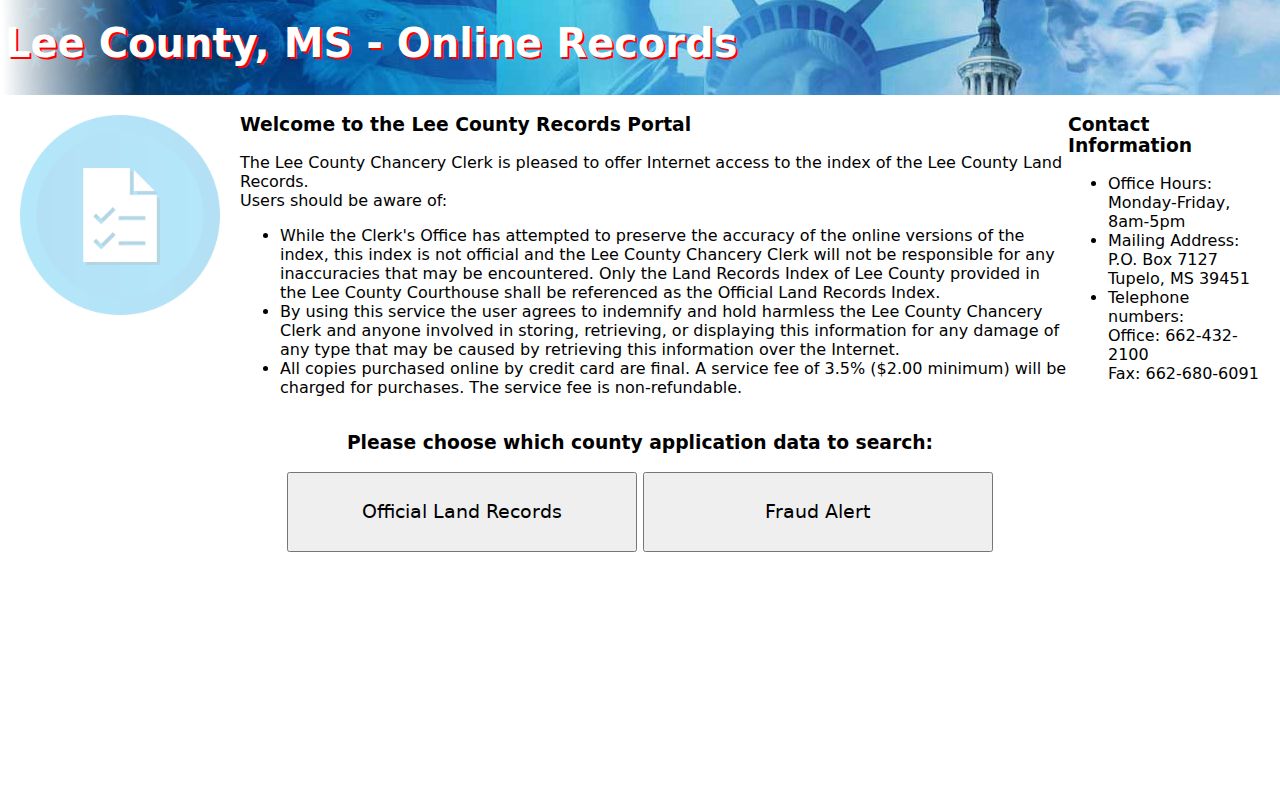
The official DuProcess landing screen shows the web index as a convenient front end, while the courthouse Land Records Index remains the authoritative record of every Lee County filing.
Walk Lee County Deeds Backward
A chain starts with the latest credible owner clue. From there, work backward deed by deed. Search the name as a grantee. Open the image and compare the legal description, not just the address. The grantor on that deed becomes the grantee in your next, earlier search. Search forward from each prior owner too, since a later corrective deed or a differently worded conveyance can affect the same Lee County land.
- Use the assessor name as a lead and find that party's newest matching grantee instrument.
- Save the recording date, instrument number, book/page, deed type, parties, and full legal description.
- Search the named grantor as a grantee in an earlier range, then repeat the comparison.
- Stop and branch into probate, court, plat, or archive records when the transfer path or description changes.
- Grantor
- The party transferring the stated interest.
- Grantee
- The party receiving the stated interest.
- Chain of title
- The linked sequence of instruments affecting the same land.
- Book/page
- A volume reference; an instrument number is a separate filing key.
Official Lee County Deed Check
CRMS is a practical search aid, but Lee County calls the web index informational. The courthouse Land Records Index is the official source. The portal warns that names, descriptions, property types, and document types may be misspelled or incomplete. Verify key results against scanned images. Get a certified copy when proof matters. DuProcess reports daily updates except weekends and holidays. That statement says nothing about historical coverage or the Tax Assessor's update cycle. A fresh deed may still need a clerk check. No earliest online year is published, so no cutoff should be assumed.
Note: A current verification marker describes index processing, not ownership certainty or the first year available online.
Match Lee County Legal Descriptions
Street addresses help you find land, but Lee County deeds rely on legal descriptions. Copy the recorded wording in full. A mailing address will not do. Subdivision deeds cite a recorded plat. Keep the name, phase, lot, block, and square exactly as the plat lists them. Rural land may turn on section, township, range, quarter calls, bearings, distances, monuments, acreage, easements, rights-of-way, reservations, and exclusions. DuProcess offers many of these terms as search criteria. They aid a search, not replace the deed. A parcel near Tupelo's rail corridor may need searches for alley, easement, railroad reservation, or old lot numbering. The GIS polygon cannot settle those points, because the official parcel service reports missing plat and zoning fields.
Older Lee County Deed Records
Online deed records eventually stop. Ask the Chancery Clerk for the older deed books. The Mississippi Department of Archives and History notes that county deeds and tax records stay county-created even when microfilm copies exist elsewhere. Its Lee County Series 1202 holds digitized land images from 1868 and 1879. The county-record catalog may point to more microfilm.
The Tupelo courthouse burned on February 6, 1873. A new courthouse followed in 1874. That fire helps explain why an early chain may require multiple repositories, though it does not prove any particular filing was lost. The Lee-Itawamba Library Mississippi Room adds maps, newspapers, microfilm, family histories, and local context. The clerk remains the source for current certification.
The MDAH Lee County archive opens a route into early land material, not a claim that every deed book survives complete.
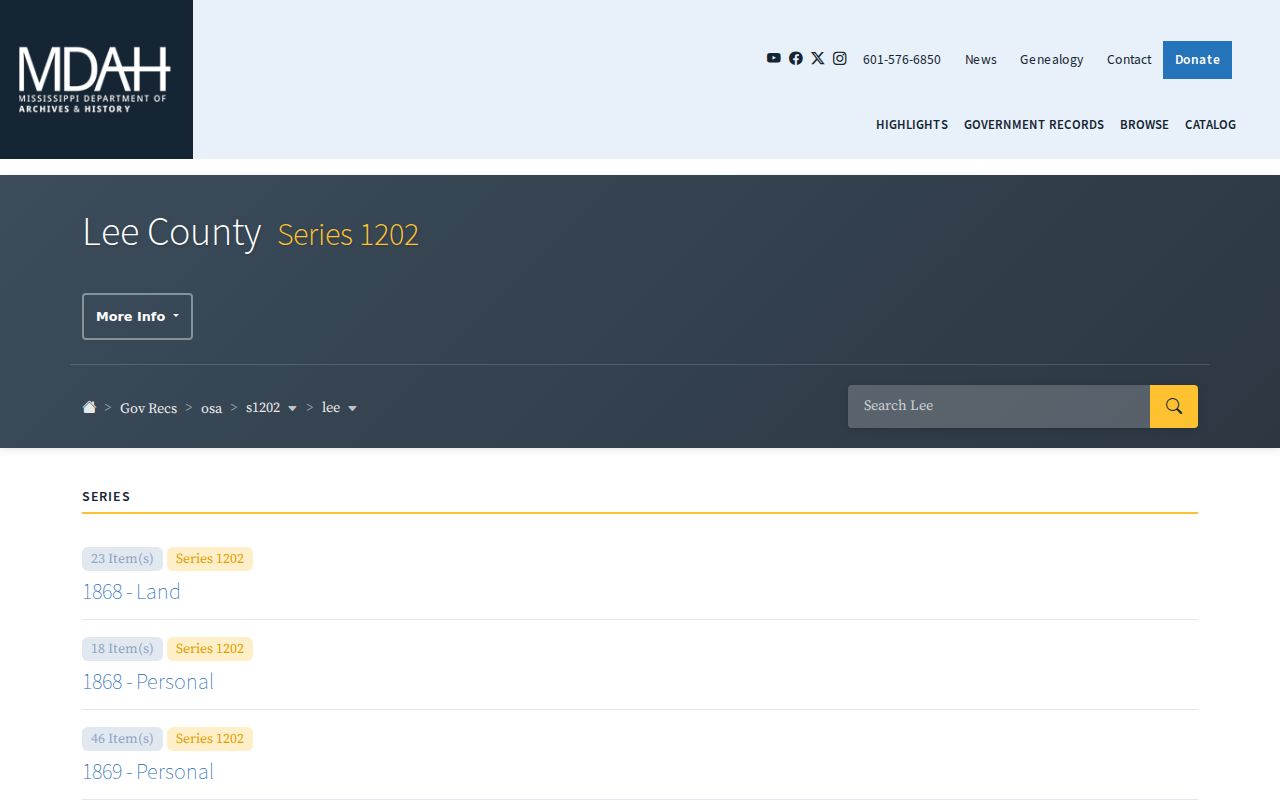
Early land research takes patience. The archive view leads into Lee County's oldest material without promising that each deed book survives or is complete.
Order a Lee County Deed Copy
Lee County deed copies come three ways: online, at the counter, or by mail. Online images are sold through CRMS. Card purchases there are final and nonrefundable. The portal adds a service fee with a minimum charge. Read the product label with care. An online copy, an eCertified item, and a courthouse-certified copy are three different products. For in-person inspection, the Chancery Clerk offers weekday public access in Tupelo. Copies you make yourself cost $0.25 per page, while staff-made copies run $0.50 per page. Certification adds $1 per document. A mailed request should spell out the parties and the approximate year. Name the instrument type and a book/page or instrument number. Add the parcel or PPIN, the legal description, and the copy type you want. Include the stated payment method and a stamped self-addressed envelope. Confirm the current mailing address before it goes out. The Chancery Clerk office page publishes these holdings and copy terms.

The official office page carries the current counter, mail, payment, and certification instructions.
Recorded, not guaranteed. Lee County deed records show filings accepted into the record. They do not resolve every unrecorded interest, lien priority, boundary issue, or title defect.
When Lee County Deeds Branch
A deed chain can bend through foreclosure, quiet title, partition, probate, or a tax proceeding. A boundary case can bend it too. Lee County sits in the First Chancery District. MEC and PAMEC can supply case and docket context, though registration and fees may apply. Sealed or restricted documents stay unavailable. Status flags like CLOSED, SEALED, TRUST, LEGACY COMPLETE, and LEGACY INCOMPLETE often explain a gap. They reveal why an instrument is missing from an online view. Search the recorded lis pendens, judgment, trustee's deed, commissioner's deed, estate conveyance, or corrective deed in the land index too. Do not stop at the case file. A court narrative may explain a transfer. It is not always the conveyance itself. Keep the case number handy, then return to the exact recorded instrument.