
Read Lee County Property Tax Records
Tax records in Lee County are split by function. The Tax Assessor keeps the appraisal roll, maps, value data, and the homestead path. The Tax Collector gathers ad valorem taxes. It also carries the payment and delinquency context. Read the assessment year, the bill year, and the status side by side. One current parcel screen cannot explain every older balance or sale event.
| Field | What It Shows | Where |
|---|---|---|
| True or market value | Appraisal base before the class ratio | Tax Assessor roll |
| Assessed value | Ratio-adjusted amount used with millage | Tax Assessor roll |
| Land and improvements | Components of the parcel appraisal where displayed | Delta appraisal result |
| Exemption | Homestead or other relief applied to the roll | Tax Assessor |
| Bill and status | Tax year, amount, payment, or delinquency | Tax Collector and Delta links |
The tax bill grows from assessed value. It does not grow from local millage alone, nor from whatever a deed happens to state. A recorded sale amount can be nominal or partial. It may reflect a family or estate transfer instead of a market price. Keep sale evidence and the tax calculation in separate folders.
Lee County Residential Assessment Ratio
Under Mississippi Department of Revenue guidance, owner-occupied residential property falls in Class I. It is assessed at 10 percent of true value. That ratio produces the assessed value. Local millage then applies to the assessment, subject to exemptions and other roll rules. So a parcel's assessed figure can sit far below a market estimate. That is not an error.
The state also requires local real-property revaluation at least once every four years. Annual roll work and a four-year cycle are not a live sale appraisal. When reviewing Lee County property tax, compare like years and like categories.
- True value
- The appraisal base used before the statutory class ratio.
- Assessed value
- The ratio-adjusted value used in the tax formula.
- Millage
- The local levy applied to assessed value.
- Homestead exemption
- Relief for qualifying owner-occupied property under state and county rules.
- Tax lien
- A claim arising from unpaid property tax, not automatic ownership.
Find Lee County Assessment Fields
The Delta Real Property Appraisal portal accepts an owner name, an address number and street, a Parcel Number, and a PPIN. Start with one field. Preserve the exact parcel key once it returns. A parcel result may show owner or display name, situs and mailing data, legal text, land and improvement values, assessed and taxable values, exemptions, tax district, acreage, and sale fields when the current card exposes them.
Labels and the assessor's refresh date must be checked on screen, since result cards vary. Another public schema with sale columns is no promise of a last-sale field here. The county assessor's office answers questions at 662-432-2700, and the third-party portal lists its own help number. The Lee County assessor search page displays the available lookup paths.
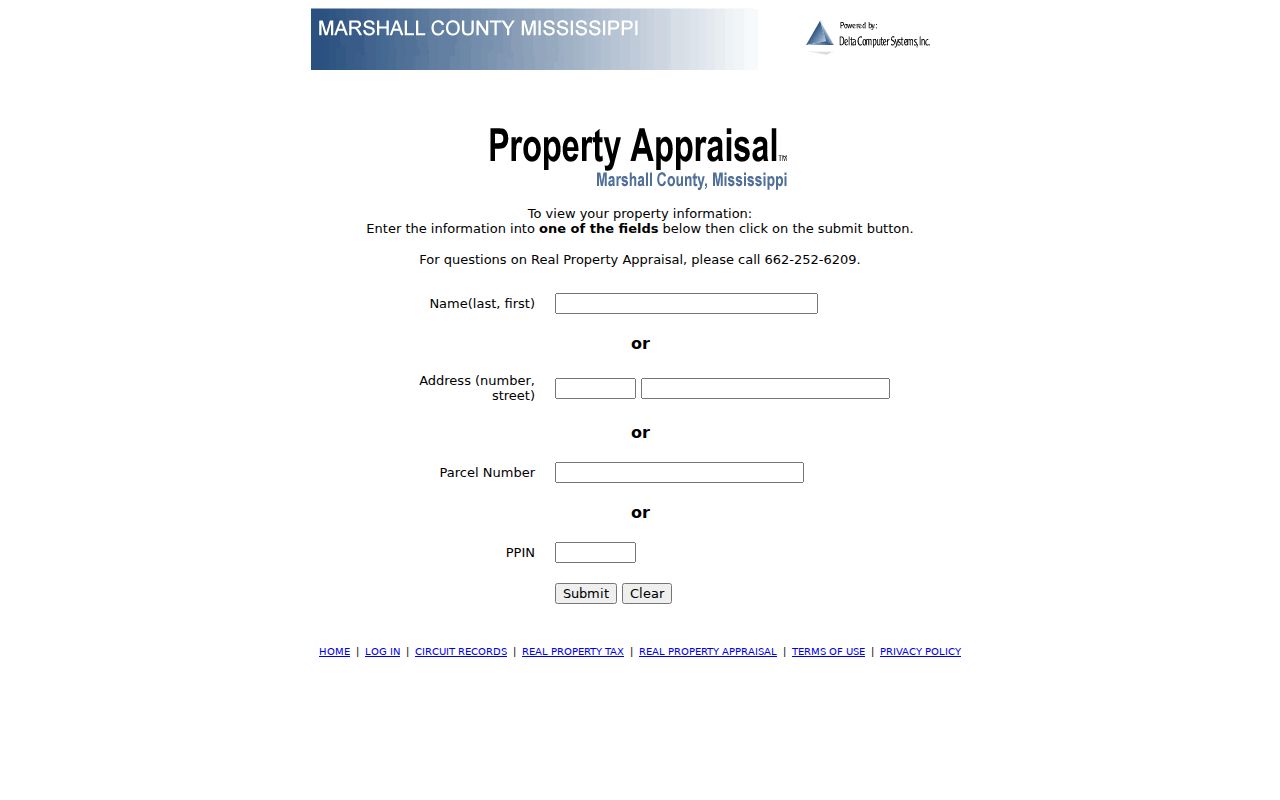
The image is a search-form record, not a sample tax account or proof of any particular owner's values.
Look Up a Lee County Tax Bill
The Delta Lee County landing page presents property appraisal as one service. It presents online tax payment as a separate service. Start from the parcel identity. Then move to the bill. A name alone can match more than one account. An address may differ from the owner's mailing destination. The portal view shows why appraisal must be opened as one record function. It also shows why payment status must be opened as another.
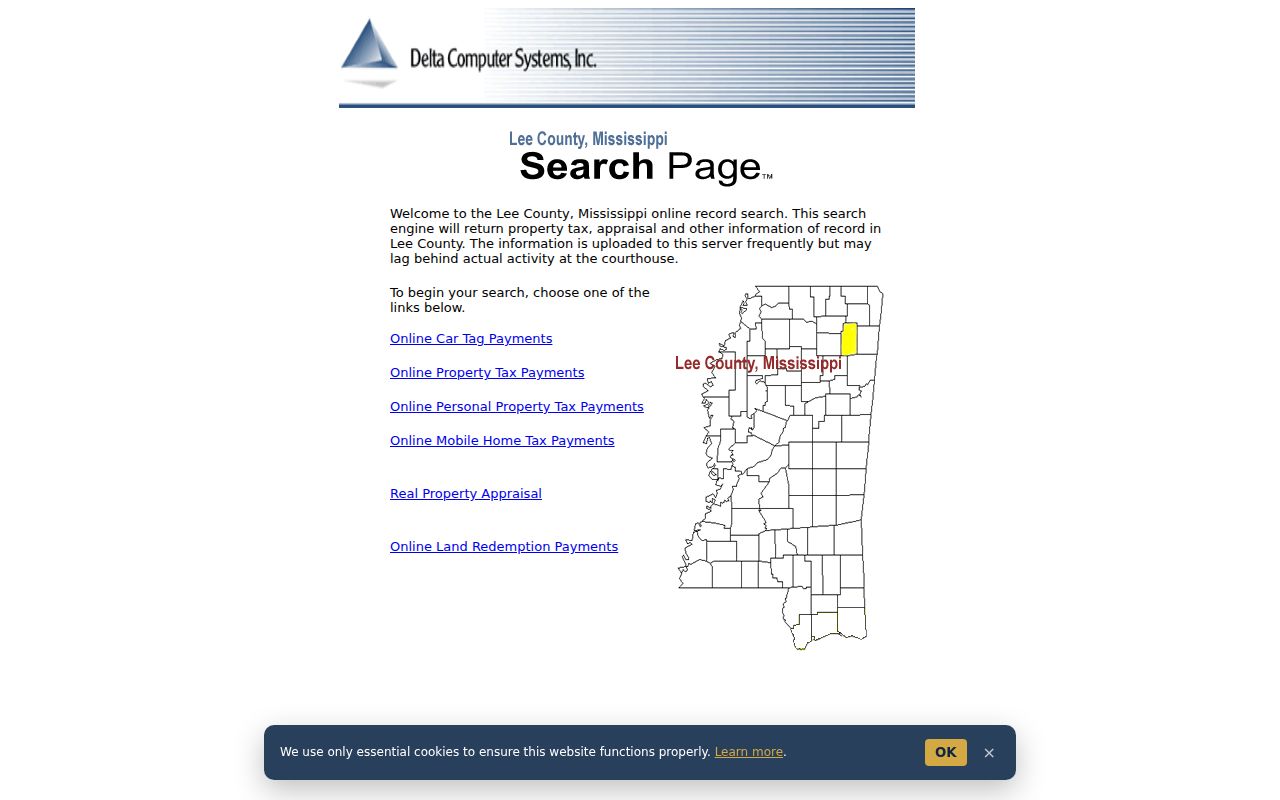
Appraisal details and payment status open as separate functions in Lee County.
- Search the assessor by address, owner, Parcel Number, or PPIN and confirm the legal description.
- Open the tax-payment route and match the same parcel before reading the current bill or prior-year status.
- Compare land, improvement, true, assessed, and taxable figures, plus any exemption shown for that year.
- If delinquent or sold, request the official sale, certificate, redemption, and matured-interest details rather than inferring title.
- Assessment year
- The year for which the parcel was valued.
- Bill status
- The collector's record of due, paid, or delinquent tax.
- Redemption
- The statutory process affecting a tax-sale certificate before a matured interest.
Lee County Homestead Timing
The Lee County Chancery Clerk takes homestead applications. The assessor keeps the roll where the relief appears. County and state material sets a filing window of January 1 through April 1. Eligibility depends on the property and the applicant's facts. A prior-year exemption should never be copied forward without checking the current record and instructions.
Keep three figures separate. One is the appraised or true value. Another is the assessed value after the class ratio. The third is taxable value after any relief. If an expected exemption is missing, contact the assessor. Keep the application, notice, and roll year. A deed alone never shows that an exemption was approved.
Note: Verify the current filing form and eligibility with Lee County before relying on a past homestead entry.
Lee County Tax Calendar
Lee County sets property taxes due on or before February 1. This applies to property assessed in the prior year. When February 1 lands on a weekend, the next Monday becomes the no-penalty date. Confirm the calendar for the tax year at issue. A general rule never replaces the current bill or county notice.
Assessment challenges run on an earlier clock. Mississippi DOR guidance says a taxpayer generally asks the county Board of Supervisors for a hearing. The taxpayer ordinarily appeals by the first Monday in August, ahead of the due date. That value or classification dispute is distinct from a delinquency, redemption, foreclosure, or title case.
Appeal Lee County Property Tax
A local assessment appeal starts with the Lee County Board of Supervisors. That process is laid out in Mississippi DOR property-tax guidance. Save the notice, parcel reference, tax year, property class, value components, exemption issue, and the reason the roll should change. Supporting facts might include correct property characteristics. Comparable evidence or proof tied to the claimed classification or exemption can also help.
The DOR Review Board route and its petition do not substitute for the county's ordinary local value appeal. The state petition inventory asks for taxpayer identity and contact details. It also asks for the issue, the notice, an explanation, attachments, and the requested relief. Decide which agency decision you are challenging before reaching for a form.
Appeal window. Mississippi guidance ordinarily places the county appeal by the first Monday in August before the due date. Confirm the current Lee County deadline and filing method.
Trace Lee County Tax Sale Status
Mississippi law sets the framework for Lee County's annual tax sale. The Lee County Tax Collector tax-sale page posts the specifics. The sale falls on the last Monday in August at 8:30 a.m. The cited code sections govern how the process runs. Delinquency details and registration steps sit one click away. The clock is not fixed, though. Let the current year's notice control over any earlier posting.

Start with the live tax-sale page rather than any saved copy. Then capture the essentials. Write down the delinquent tax year, Parcel Number or PPIN, legal description, roll owner, and sale date. Add the certificate or purchaser reference, redemption status, and notices. Include any matured lien, deed, or judgment. Every detail matters here. Two county offices share this work, so plan to reconcile them. The Chancery Clerk reports on taxes that have gone to sale or matured after the two-year period. The collector runs the tax-sale path itself. One warning deserves attention. Paying property tax on a parcel for seven years does not automatically create ownership. A purchaser at sale acquires a tax lien or certificate subject to redemption rules. That is not instant clear title. For the collection side of ad valorem taxes, the Lee County Tax Collector page explains the office's role.

The office view helps separate collection questions from appraisal and deed-record questions.
Four Lee County Record Clocks
A single tax inquiry can pull dates from four different systems. CRMS keeps a recording clock for deeds and related instruments. The assessor keeps a roll clock for owner, value, and exemption fields. The exact refresh cycle is not posted. GIS runs on a layer clock of its own. Municipal permits carry application, approval, inspection, and certificate dates. Assume none of them match. The newest deed grantee may differ from the tax-roll owner or the map display. Label each date. Note the source. Investigate the update cycle and the exact parcel. Overwriting one official record with another is never the fix. Value categories are a different question. The site's property value page is the place to look for those.