
Trace Lee County Former Owners Through Each Transfer
A former-owner chain grows one recorded transfer at a time. Begin with the current legal description and the newest acquisition deed. Each grantor then becomes the next grantee. Street addresses help at the start. They lose their grip once a number changes. Lee County's lot, block, subdivision, section, township, range, parcel, PPIN, book/page, and instrument fields supply the continuity a deed chain needs to survive those changes.
| Chain step | Transfer evidence | Lee County source | Detail to retain |
|---|---|---|---|
| Current acquisition | Current grantee received title from prior grantor | CRMS instrument result and image | Recording date, deed type, instrument, book/page |
| Previous transfer | That grantor's earlier acquisition as grantee | DuProcess grantor-grantee index | Both party names, legal description, consideration |
| Older indexed chain | Earlier deeds, plats, corrective instruments, estates | Courthouse Land Records Index | Related items, legal text, image or certified copy |
| Early land trail | Historic land image or microfilm lead | MDAH Series 1202 and county-record microfilm | Repository, year, series, reel, image, gaps |
Expect a working timeline, not a tidy single row. Every transfer does not fit one line. A corrective deed, estate order, partition, commissioner deed, or rewritten legal description can force a side branch before the former-owner chain continues.
Lee County Previous Owners Appear in Both Party Directions
The DuProcess land-record index keeps grantor, grantee, searched-name, and cross-party results separate. A seller shows up as grantor on the outgoing deed. That same person appears as grantee on the earlier deed. That deed conveyed the parcel to them. Searching only one direction can end a chain too soon.
| Portal field | How it advances the history | Check alongside it |
|---|---|---|
| Full Name | Finds a former owner by indexed spelling | Initials, punctuation, married names, entity suffixes |
| Grantor Party | Identifies who conveyed the parcel | Grantee and instrument type |
| Grantee Party | Identifies who received the parcel | Prior grantor and recording date |
| Book / Page or Instrument | Returns directly to a cited record | Image status and related items |
| Legal Desc. / Parcel ID / PPIN | Keeps the search tied to the land | Subdivision, lot, block, section, township, range |
The official search screen opens many field families:
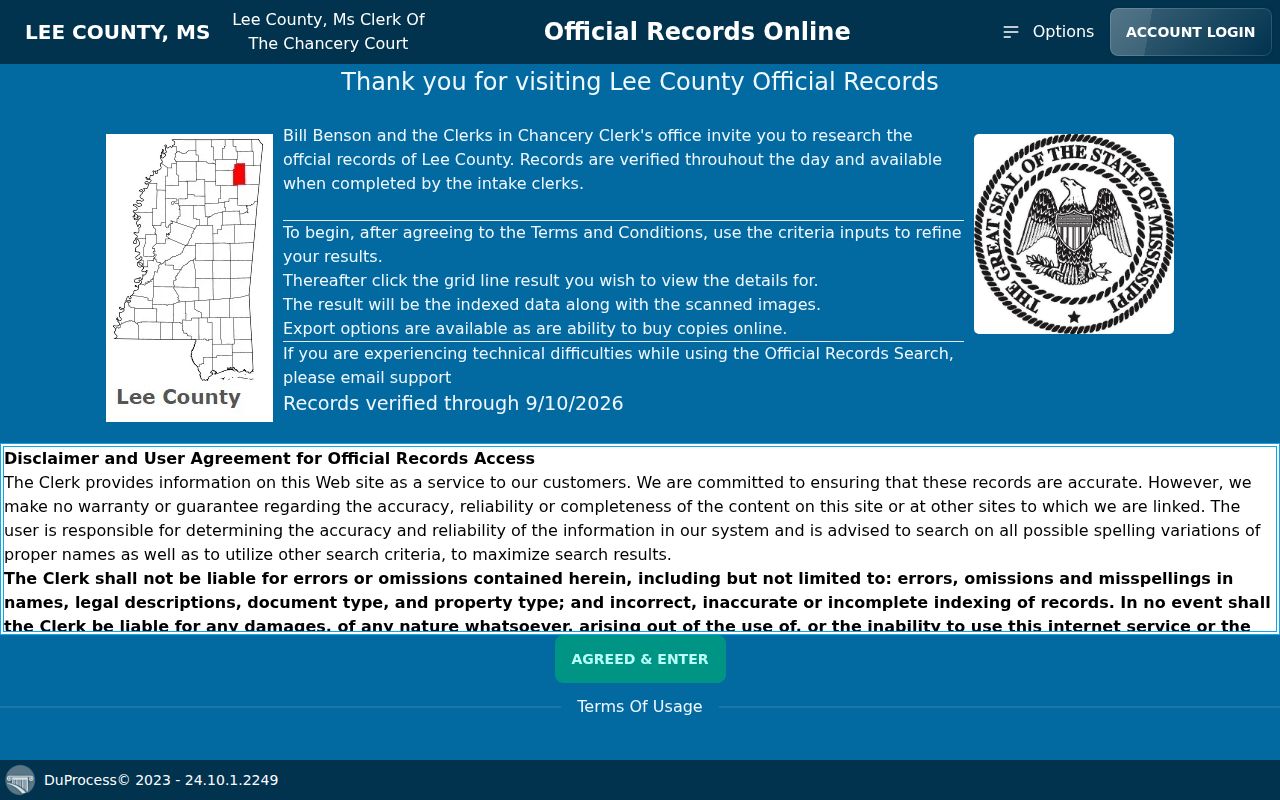
Indexed names can be misspelled. Descriptions may run incomplete as well. Use spelling variants, reveal the hidden result columns, and compare the deed image before adding a name to the Lee County ownership chain.
The Courthouse Index Controls Lee County Ownership History
CRMS is a strong research route, but the county records landing page calls the web index informational. The courthouse Land Records Index is the official record. That gap matters when spellings differ. It matters as well when an image is missing or a legal description was shortened during indexing.
The Lee County Chancery Clerk allows in-person inspection on weekdays during posted office hours. Mail requests work too. Send identifying detail, payment, and a stamped self-addressed envelope. Public-made paper copies cost $0.25 per page. Staff-made copies run $0.50 per page. Certification adds $1 per document. Online card purchases carry the portal's separate service fee and are not automatically certified.
For any mailed or counter request, provide the grantor and grantee, the approximate year, the instrument type, the book/page or instrument number, the parcel or PPIN, and the legal description. Say whether a certified copy is needed. The Chancery Clerk office page lists phone contact, which helps when an old book must be located.
Note: Ask for both the index entry and the document image whenever one former-owner link affects a purchase, estate, or boundary decision.
Reconstruct Lee County Former Owners Backward
A backward walk anchors on the land itself, not just on the parties. Keep a worksheet for every transfer. That discipline keeps a similar personal name or a nearby parcel from slipping into the sequence. The full deed, not a result row, proves continuity.
- Find the present parcel card, then locate the current owner's newest acquisition deed with that owner as grantee.
- Read the prior owner as grantor and transcribe the full legal description, instrument number, book/page, and recording date.
- Search that grantor as an earlier grantee. Compare parcel, lot/block, or section-township-range details before accepting the match.
- Repeat the cycle, checking forward from each former owner for corrections, later conveyances, and related instruments.
- When online results stop, take the last sound citation to the courthouse index, deed books, MDAH catalog, or microfilm.
- Grantor
- The party conveying an interest in the recorded instrument.
- Grantee
- The party receiving the interest stated in that instrument.
- Chain of title
- The ordered sequence of conveyances affecting the same land.
- Reverse index
- An index route organized to follow parties in the opposite role or direction.
- Warranty and quitclaim deeds
- Different deed forms whose legal effect cannot be judged from the label alone.
Not every recorded item transfers ownership. Side documents are common. A deed of trust, release, easement, or lien may sit beside a conveyance, so record it as a related event and keep the sequence on the instrument that actually conveyed the parcel.
Legal Descriptions Keep Lee County Prior Owners Connected
People sell, marry, and rename streets, so a name alone is a shaky thread. A legal description holds up better. For a lot inside a subdivision, keep the recorded subdivision name, the phase, lot, and block. Keep the plat reference too, along with any easements or covenants. Rural land in Lee County works differently. There the chain hangs on section, township, and range, quarter designations, metes-and-bounds calls, and patent references. It also leans on road or right-of-way names.
The DuProcess index gives you several ways in. It accepts subdivision, lot, block, section, township, range, quarter-grid, street, patent, parcel, and PPIN criteria. Those routes matter. A prior owner may appear in the property records under an initial, an estate, a trust, or a business name. They also keep two Lee County residents with matching surnames from blurring together.
Parcel numbers shift over time. A split, a combination, a correction, or a reassessment can each occur. Any of them can force a new identifier into the tax roll. So keep every old number in the chain instead of swapping it for today's format. A historic plat name can likewise outlast the street address the assessor uses now.
Note: A shared surname alone proves little. A matching legal description plus connected deed records builds a far stronger historical link.
Lee County Estate and Court Transfers Can Bend the Chain
Not every transfer shows up as a clean sale deed. Estates, heirship disputes, partitions, foreclosures, quiet-title suits, tax proceedings, and commissioner deeds can all move title in Lee County. There may be no direct conveyance between the parties you expected. That gap is normal. The deed index and the court docket each hold one half of the explanation. So a chain with a missing link usually calls for both.
Lee County sits in the First Chancery District. The official court information page opens the door to MEC/PAMEC access. Registration, fees, and restrictions may apply. A docket search can surface an order or case number tied to the transfer. The Chancery Clerk's land records then confirm whether a deed actually followed the court's ruling.
Pull related instruments from the same window too. Affidavits, corrective deeds, powers of attorney, releases, lis pendens, and tax-lien filings often sit beside the main document. They often explain odd jumps in ownership. Place the court event on your timeline. Just never treat it as the recorded transfer itself. Only the deed records establish who became the new owner of record.
Lee County Land Images Open an Earlier Research Door
Older paper can take you past the reach of a modern search engine. The Mississippi Department of Archives and History Series 1202 holds Lee County land images labeled 1868. Others are labeled 1879. Those images can push a former-owner search back generations. Just treat the labels as guides rather than guarantees. They do not promise a complete deed chain or certified copies from the recorder.
The archive's image index shows how the early land material is grouped.
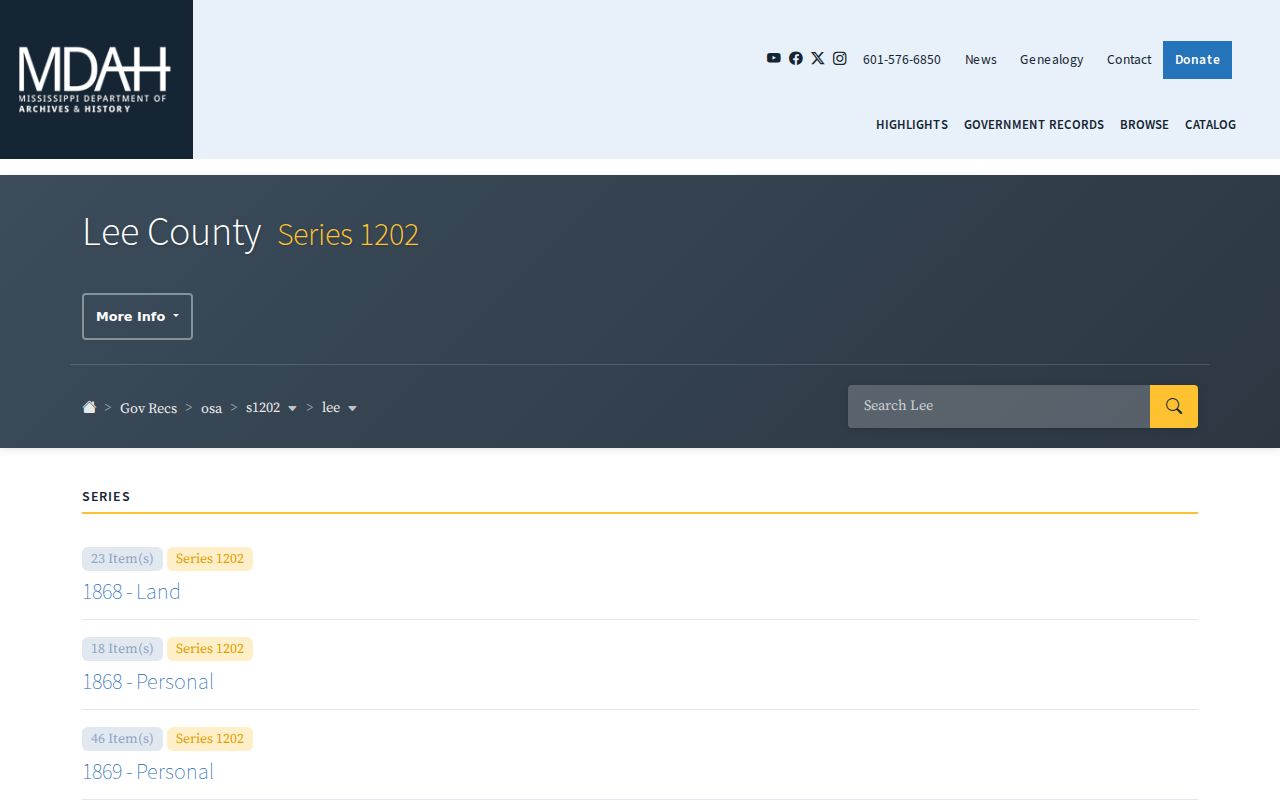
Treat the series and image references as leads, not conclusions. Then compare the land description against the courthouse deed records. For anything not digitized, the MDAH county-record microfilm catalog and its research catalog can point you to a reel or finding aid.
The 1873 Fire Changes a Lee County Chain Strategy
Lee County was formed in 1866. Tupelo became the county seat a year later. According to Tupelo's historic-preservation material, the courthouse burned on February 6, 1873. A replacement opened in 1874. That fire explains why an early owner-of-record trail may wind through several repositories. It does not prove any particular deed was lost.
Suppose you hit a gap in the 1860s or early 1870s. Start with current CRMS variants, then ask the courthouse about old books and indexes. From there, inspect the 1868 and 1879 MDAH series and the county microfilm. The Lee-Itawamba Library's local-history holdings round out the route with maps, newspapers, and family histories. Secondary material guides discovery. An official instrument still settles the question.
This layered approach beats pinning a tidy start date on the chain. It also leaves the uncertainty visible. The next researcher can audit your steps.
How Far Back Lee County Former Owners Can Be Traced
The county publishes no stated starting year for its online deed index. Coverage of the older books varies. Confirm the earliest reach with the clerk before you rely on the portal. Its displayed verification date reflects current indexing work, not the first historical year on file.
Once the web trail runs out, take your oldest confirmed deed citation to the courthouse index in person. Deed books, plats, MDAH microfilm, early land images, and newspaper or library clues can then extend the property records chain. Record every repository, date, book, page, reel, series, and image number. Note each unresolved interval too. Gaps are common. When one affects a live transaction or a legal opinion, bring in a title professional.
Coverage limit. Lee County does not publish an exact online start year for CRMS. Do not invent a cutoff; ask the clerk about older deed books and microfilm.
Tracing former owners through Lee County property records serves real purposes: house history, estate work, diligence before buying or selling, and boundary study. It must never be used to stalk, threaten, or harass a living person.